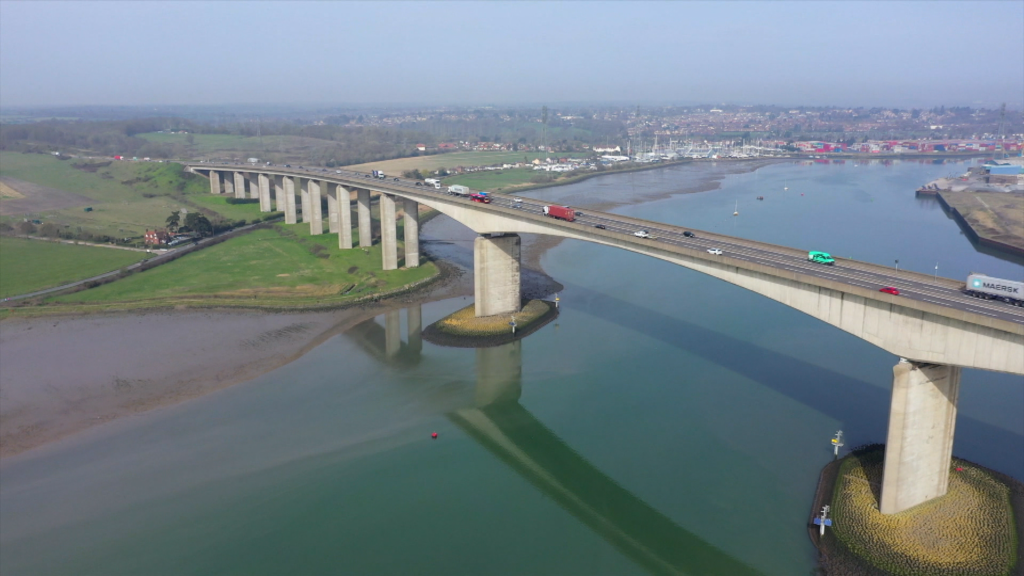

The Orwell Bridge is one of Suffolk’s most vital transport links, carrying the A14 over the River Orwell south of Ipswich. For commuters, freight drivers, and local businesses, an Orwell Bridge closure is far more than an inconvenience — it disrupts supply chains, extends journey times, and places pressure on surrounding roads. Whether caused by high winds, emergency incidents, or planned maintenance, these closures affect thousands of drivers every year. This article explains why the bridge closes, what work has been carried out, what diversion routes are available, and what the future holds for this critical piece of infrastructure.
Why Does the Orwell Bridge Close?
The most common reason for an Orwell Bridge closure is high wind. Due to its exposed position and elevated height above the River Orwell, the bridge is particularly vulnerable to gusts that pose a serious risk to high-sided vehicles such as lorries and vans. Under the current closure protocol managed by National Highways, a 40mph speed limit is imposed when winds are forecast to exceed 50mph. If gusts reach 60mph or above, the bridge is closed entirely to protect road users from the risk of vehicles being blown over.
How the Wind Protocol Has Evolved
Prior to January 2021, the Orwell Bridge was closed to all traffic whenever gusts of 50mph or more were recorded in certain wind directions, or when speeds hit 60mph regardless of direction. Following extensive safety testing and an independent study commissioned from experts at City, University of London — which used wind tunnel analysis to assess how different vehicles are affected — National Highways introduced a revised protocol. The updated approach introduced the 40mph speed restriction tier, allowing the bridge to remain open more frequently during moderate high-wind events while still prioritising safety.
The 2025 Maintenance Works
Beyond weather-related disruptions, planned maintenance has been a significant source of Orwell Bridge closures in recent years. In the summer of 2025, National Highways undertook a major programme of works to replace two critical expansion joints on the westbound carriageway. These joints help the bridge expand and contract with temperature changes, preventing long-term structural damage. The work was part of a £6 million investment aimed at improving the bridge’s durability and long-term safety. The project represented one of the most significant interventions on the structure in recent memory.
Timeline of the 2025 Closure Programme
The 2025 maintenance programme was phased carefully to minimise disruption while ensuring the works could be completed safely. Monday 16 June, overnight lane closures ran between 8pm and 6am. From 20 to 26 June, full overnight carriageway closures were in effect, including weekends. From 26 June until August 2025, both carriageways operated with one lane open in each direction through a contraflow system. Although the main works concluded ahead of schedule, finishing touches in November caused further overnight disruptions. Future eastbound carriageway works have been discussed but remain unscheduled.
Diversion Routes During Closures
When an Orwell Bridge closure is in effect, National Highways implements official diversion routes to keep traffic moving, though delays are still likely on alternative roads. During full closures, official diversions redirect traffic between Junction 58 and Junction 55 via the A12 and A1214. The A12 handles the bulk of long-distance traffic, while the A1214 provides better local access into Ipswich. Junction 57 is typically closed at the westbound entry point during maintenance, and Junction 58 commonly sees higher congestion when diversions are in effect. Drivers are advised to plan ahead and monitor live traffic updates before travelling.
Impact on the Region and Local Communities
The repeated Orwell Bridge closures have had a measurable impact on businesses, freight operators, and everyday commuters across Suffolk. The A14 is a key freight corridor linking the Port of Felixstowe — the UK’s busiest container port — with the national motorway network. Any significant closure adds time and cost to haulage operations. The 2025 closures also highlighted the region’s ongoing transport challenges, with Suffolk continuing to rely on ageing infrastructure while other parts of the country received major new funding commitments. Local voices have consistently called for greater investment in the East of England’s transport network.
What to Expect Going Forward
While the major 2025 maintenance programme has concluded, the prospect of future Orwell Bridge closures remains. Short-term overnight lane closures may still occur for minor adjustments or emergency responses, and National Highways has indicated that the eastbound expansion joints may also be addressed in a future phase. Weather-related closures will continue to occur whenever wind conditions pose a safety risk. Drivers who regularly use the bridge are encouraged to sign up for email bulletins from National Highways, which provide advance notice of planned closures and speed restrictions, helping commuters and freight operators plan their journeys more effectively.
FAQs
Q: What wind speed triggers an Orwell Bridge closure?
Under the current National Highways protocol, the bridge is closed to all traffic when wind speeds of 60mph or more are forecast. A reduced speed limit of 40mph is applied when winds are predicted to exceed 50mph, allowing the bridge to remain open under moderate high-wind conditions.
Q: What is the best alternative route when the Orwell Bridge is closed?
The primary diversion recommended by National Highways runs via the A12 and A1214 between Junction 55 and Junction 58 of the A14. While this adds journey time, it is the most reliable official alternative for both local and long-distance traffic.
Q: How can I find out if the Orwell Bridge is closed before I travel?
National Highways maintains a dedicated page for the Orwell Bridge on its website, where live closure and speed restriction data is published. Drivers can also sign up for email bulletins to receive advance notice of planned closures and maintenance windows.
Q: Will there be more planned closures after the 2025 maintenance works?
No new major closures have been officially announced following the completion of the 2025 expansion joint replacement programme. However, National Highways has indicated that future work on the eastbound carriageway may be required. Minor overnight closures could also occur at short notice if inspections reveal defects.
Q: Why is the Orwell Bridge so vulnerable to high winds?
The bridge’s elevated position above the River Orwell, combined with its length and exposed location in the Suffolk landscape, makes it particularly susceptible to strong crosswinds. High-sided vehicles such as lorries and vans face the greatest risk during gusts, which is why wind-speed thresholds are used to determine when it is safe to keep the bridge open.
Conclusion
The Orwell Bridge is a critical piece of infrastructure for Suffolk and the wider East of England, and its closures — whether weather-driven or maintenance-related — carry real consequences for commuters, businesses, and freight operators. The revised wind protocol introduced in 2021, combined with the significant 2025 investment in expansion joint replacement, reflects ongoing efforts by National Highways to improve the bridge’s resilience and reduce unnecessary disruptions. Staying informed through official channels remains the best way for drivers to manage the impact of any future Orwell Bridge closure on their daily journeys.