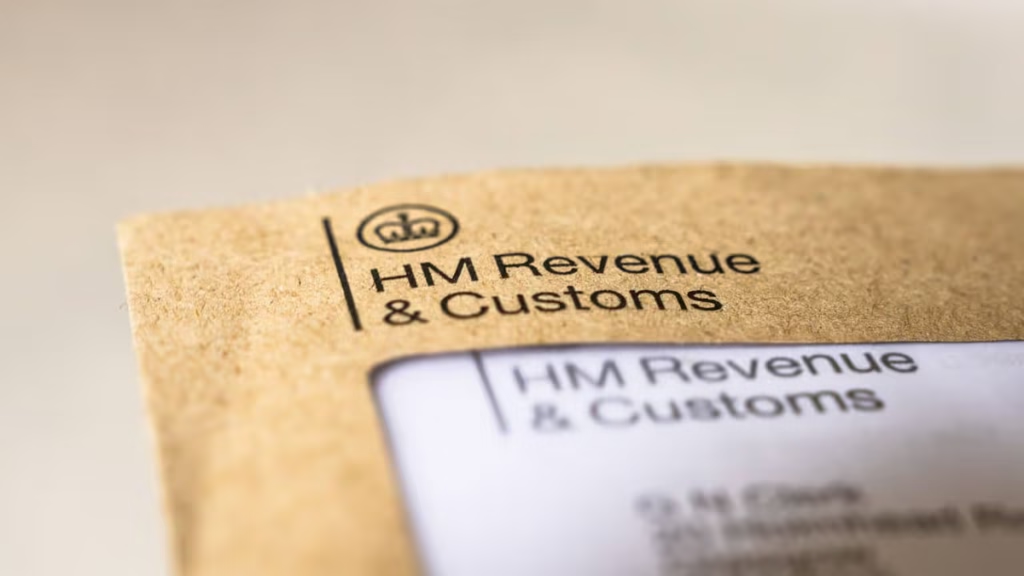

Thousands of UK savers have received HMRC savings account tax letters in 2025 and 2026 — and many are confused about what they mean. These notices are not random. They are triggered when the interest earned on your savings exceeds your Personal Savings Allowance (PSA), the annual tax-free limit set by the government. With interest rates on standard savings accounts hovering around five percent and the PSA frozen since 2016, even modest balances are now pulling ordinary savers into taxable territory for the first time in years.
How HMRC Knows About Your Savings Interest
One of the most common questions savers ask is: how does HMRC find out about interest on my savings account? The answer lies in automatic data sharing. Banks, building societies, credit unions, and peer-to-peer lenders are legally required to report the total interest paid to each account holder directly to HMRC at the end of every tax year. This means HMRC receives your savings interest data without you needing to declare it, unless your interest exceeds £10,000, in which case a Self Assessment tax return is mandatory. The process is fully automated and highly accurate.
| Tax Band | Annual Income | Tax-Free Savings Allowance |
| Basic rate | Up to £50,270 | £1,000 |
| Higher rate | £50,271 – £125,139 | £500 |
| Additional rate | £125,140 and above | £0 |
The Three Types of HMRC Savings Tax Letters
Not all HMRC savings account tax letters carry the same meaning or urgency. Understanding which type you have received is the essential first step before taking any action. Each letter serves a different purpose depending on how you are paid and how much tax is owed. Check the reference number on the letter and log in to your HMRC Personal Tax Account, where the same notification will also appear online.
Letter Type 1
P800 Tax Calculation
Sent to employed savers or those with a private pension. HMRC adjusts your tax code so the owed amount is collected gradually from future pay or pension income — no lump sum required.
Letter Type 2
Simple Assessment (PA302)
Commonly issued to pensioners and those whose tax cannot be collected via PAYE. This is a direct bill from HMRC for unpaid tax on savings interest. It requires payment within 60 days.
Letter Type 3
PAYE Coding Notice
A notice that your tax code has been changed to account for taxable savings interest in the year ahead. It explains the revised code and the reason for the adjustment.
Who Is Most Likely to Receive a Letter in 2026?
While anyone whose savings interest exceeds their PSA could receive an HMRC savings account tax letter, certain groups face a higher risk in the current environment. Pensioners are particularly affected because Triple Lock increases to the State Pension have pushed many retirees’ total income above the tax-free Personal Allowance of £12,570. Higher-rate taxpayers are also more exposed because their PSA is only £500 — meaning a balance of just £3,500 in a five-percent account can generate enough interest to trigger a letter. Fixed-rate bond holders whose interest matures in a single lump sum are another vulnerable group.
What Happens If You Ignore an HMRC Tax Letter?
Ignoring HMRC savings account tax letters is never advisable. If left unaddressed, HMRC may adjust your tax code without your input, potentially leaving you with a noticeably reduced monthly income. A formal tax bill may follow, and late payment interest — currently set at 8.5 percent as of April 2026 — will accrue on any unpaid balance. Continued non-compliance can result in a £100 initial penalty for late filing, with further daily charges building after three months. In serious cases, HMRC may open a formal investigation. Responding promptly, even if you simply confirm the figures are correct, removes the risk of escalation.
How to Respond to Your HMRC Savings Tax Letter
When an HMRC savings account tax letter arrives — whether by post or digitally — the response process is straightforward if you act quickly. Start by gathering your bank statements and totalling the interest you received during the relevant tax year. Compare that figure against your applicable PSA. If HMRC’s calculation looks correct, follow the payment or acknowledgement instructions on the letter. If you believe there is an error, contact HMRC directly using the reference number provided. Do not use third-party services charging fees for this process — it is always free to respond directly through GOV.UK or by phone.
- Log into your HMRC Personal Tax Account at gov.uk and check the notice online
- Gather bank statements and calculate your total interest for the tax year
- Compare your interest total against your Personal Savings Allowance
- If correct, follow payment or tax code acknowledgement instructions
- If incorrect, contact HMRC directly with supporting documents
- Keep all savings interest statements for at least six years
How to Reduce Your Savings Tax Liability Going Forward
If you have received HMRC savings account tax letters, there are legitimate steps you can take to reduce future liability. Moving savings into an Individual Savings Account (ISA) is the most effective option — ISA interest is completely tax-free and does not count towards your PSA. Premium bonds and some government-backed accounts also offer tax-free returns. If your non-savings income is below £17,570, you may qualify for the Starting Rate for Savings, allowing up to £5,000 in savings interest at zero percent tax. Reviewing where your savings are held and spreading balances strategically can make a significant difference to your annual tax position.
FAQs
Why have I received an HMRC savings account tax letter if I never filed a tax return?
You do not need to file a tax return for HMRC to issue a savings tax letter. Banks and building societies automatically report savings interest to HMRC each year. If that interest exceeds your Personal Savings Allowance, HMRC can identify the liability and contact you directly — regardless of whether you have ever completed a Self Assessment return. This process is entirely automated.
Does a savings tax letter mean I have done something wrong?
No. Receiving an HMRC savings account tax letter does not mean you have broken any rules. These letters are compliance check notices, not penalty warnings. They simply indicate that HMRC has identified a potential tax liability on your savings interest and wants you to review your position. They are increasingly common as interest rates have risen while the Personal Savings Allowance has remained frozen since 2016.
Are ISA savings accounts included in HMRC savings tax calculations?
No. Interest earned within an Individual Savings Account (ISA) is completely tax-free and is not reported to HMRC as taxable income. ISA interest does not count towards your Personal Savings Allowance. This is precisely why moving savings into an ISA is widely recommended as the most straightforward way to shield interest income from tax and avoid receiving future HMRC savings letters.
What is the deadline for responding to an HMRC Simple Assessment savings letter?
If you receive a Simple Assessment (PA302) letter, you typically have 60 days to pay the tax bill or query it if you believe it is incorrect. Missing this deadline will result in late payment interest being applied at the current rate of 8.5 percent annually. If you cannot pay in full, contact HMRC to arrange a Time to Pay agreement before the deadline passes to avoid penalties.
Will HMRC send paper letters or digital notices in 2026?
From March 2026, HMRC has moved to a digital-by-default approach for most taxpayer communications. If you have accessed the HMRC app or set up a Personal Tax Account online, notices are likely to appear there rather than arrive by post. Paper letters are still issued for those who are digitally excluded or have not opted into online communications. It is worth checking your Personal Tax Account regularly, especially around the end of the tax year in April.
Summary
HMRC savings account tax letters are becoming increasingly common as rising interest rates push more ordinary savers beyond the Personal Savings Allowance — which has been frozen at £1,000 for basic-rate taxpayers since 2016. Banks report savings interest directly to HMRC, meaning these letters are data-driven and accurate. They come in three main forms: the P800 tax calculation, the Simple Assessment bill, and the PAYE Coding Notice. None of them should be ignored. The most effective response is to verify the figures, act within any stated deadline, and consider moving savings into an ISA to reduce future liability. Always use official GOV.UK channels for free guidance and support.